

Space for NHS
From exploring distant stars to satellite communications, the technology developed for space is being brought down to Earth for the NHS.

From exploring distant stars to satellite communications, the technology developed for space is being brought down to Earth for the NHS.
Feature article for the UK Space Agency’s magazine, SPACE:UK - ISSUE 51.
Every two minutes someone in the UK is diagnosed with cancer. Our body is made up of trillions of healthy cells that grow, divide and adapt to our needs. But with cancer, it’s a different story. Damaged or abnormal cells grow, surviving when they should die, and new cells develop when they are not needed. Symptoms include rapid weight loss, night sweats and fatigue. But diagnosis can be difficult.
“You can miss things if you’re just taking a medical history in the setting of a GP surgery – someone could be tired for a range of reasons,” says Christina Mackaill, an emergency care specialist at Queen Elizabeth University Hospital in Glasgow.
“Sometimes cancer doesn’t even have symptoms at the beginning. But the aim of the game is earlier detection, that’s what the NHS and the space industry are trying to achieve.”
As part of last year’s 70th anniversary celebrations of the founding of the NHS, the UK Space Agency and NHS announced a £5 million fund to adapt space technology for patient care. One of the winners of this open competition was space imaging company Adaptix. Based at the Rutherford Appleton Laboratory at Harwell near Oxford, it’s using x-ray detection technology originally designed to spot exploding stars and black holes.
Adaptix’s device consists of two vertical flat panels, both the size of a pizza box, that move in parallel as the patient stands in between them. One is made up of small X-ray emitters, which fire off X-rays in multiple directions. These travel through the patient to reach a detecting panel and produce a detailed 3D image. The technique not only avoids the traditional (and drawn-out) need to physically move the X-ray source to create an image but the patient receives a fraction of the radiation dose of a CT scan.
“Cancers can go undetected with 2D X-rays,” says Mackaill. “The potential benefit of this technology is that it could be used more quickly than a CT machine and therefore spot cancer sooner, without waiting for a hospital appointment.”
There is a long history of adapting space technology to benefit human health. In 1983, for example, NASA Space Shuttle engineer David Saucier suffered a heart attack. He was given a transplant by world-renowned heart surgeon Michael DeBakey. Later, the two realised that artificial heart pumps and Shuttle fuel pumps were similar but the heart pumps available to patients awaiting transplant left a lot to be desired. The result? A new mechanical pump that assisted the heart. The technology has become a vital, live-saving procedure for patients awaiting heart surgery.
Today, digital technology is finding new applications in medicine. Another of the winners from the UK Space Agency’s initiative is using Artificial Intelligence (AI) and satellite communications systems to target bowel cancer.
“Bowel cancer is the second most common cause of cancer-related deaths in the UK and it’s growing,” says CEO of Odin Vision, Peter Mountney.
People with suspected bowel cancer are sent for a colonoscopy. The test uses a narrow, flexible, camera to look at the lining of the large bowel. Cancer specialists are looking for small pieces of abnormal tissue, called polyps, which could develop into cancer.
“The problem is that finding them is extremely difficult and there are lots of studies to show doctors miss over 20% of these polyps,” Mountney says. “Our software is using artificial intelligence and space communications technology to help detect and diagnose cancer during the procedure, it’s like having a second pair of eyes to spot areas of abnormal tissue.”
The technology is similar to the Video Assistant Referee in football. As the doctor carries out the colonoscopy, a live video feed is sent to a cloud database via a fast and reliable data connection originally designed for high-speed satellite communication. The system, Early diAgnosis Real-Time Healthcare System for CANcer (EARTH SCAN), then uses AI to analyse the colonoscopy and identify whether or not a patient has cancer.
The AI technique at the heart of EARTH SCAN has learnt to identify cancerous tissue by comparing images of healthy bowels with signs of cancer. And there are numerous benefits. The speed of the technology means patients can receive a diagnosis straightaway, rather than having to wait for up to a month. Plus, because it’s a cloud-based system, EARTH SCAN can be accessed anywhere in the World.
“Better early detection and diagnosis, especially with bowel cancer, leads to much better outcomes for patients,” says Mountney. “Survival rate for early detection can be 90% and the cost of treating early polyps is very cost-effective compared to treating late stage cancer.” The technology will be progressing through clinical trials in the next year.
As we live longer, the NHS is under increasing pressure to treat a wide-range of age-related diseases. More than a third of all cancer cases in the UK, for example, are diagnosed in people aged 75 and over. By 2034, almost a quarter of the UK population, some 15 million people will be over 65.
“There are more and more old people, because of demographic changes which are associated with lifespan and development,” says Malcolm Jackson from the University of Liverpool’s Institute of Ageing and Chronic Disease. Jackson is leading a project called MicroAge, investigating the loss of muscle mass as we age, which is also an issue astronauts encounter when living in space.
On Earth, our muscles are constantly working against Earth’s gravity. In the weightlessness of space, however, astronauts have to exercise at least two hours a day to prevent bone and muscle loss. During his mission to the International Space Station (ISS), British ESA astronaut Tim Peake investigated this impact of the environment on his body. He had muscles samples taken before and after the mission for analysis, with MRI scans comparing the state of his tissue.
“We were struck by the fact that by trying to ameliorate the changes that go on in space, astronauts now do very large amounts of exercise on a treadmill or resistance training,” says Jackson. “Despite that, when they return to Earth they can’t walk initially – almost by definition they are not responding to exercise.”
The MicroAge team plan to send cultures of muscle tissue up to the ISS in 2021. These will be kept at ambient conditions in a special incubator, developed by Kayser Space Limited. In microgravity, the muscle samples will receive electrical stimulation to contract. Scientists will then analyse the synthesis of new muscle proteins. The same experiment will be taking place on the ground, enabling scientists to build-up a better understanding of the effects of microgravity on muscle synthesis.
If all goes well, this could be the beginning for drug-development studies that attempt to identify loss of muscle mass in elderly individuals, helping them to lead a more active life and reduce the strain on the NHS.
“We’re trying to address how we can keep people mobile and relatively healthy,” says Jackson. “A lot of that is around lifestyle and exercise and there’s potential for some selective pharmacology within that.”
Over the coming years, the benefits of space technology, communication and AI could make a significant difference to NHS care and all our lives here on Earth.
“It’s essential to have access to healthcare” says Mackaill. “These advances in technology mean that we can detect diseases earlier and more easily”.
Window on the Universe
Due for launch next year, the giant James Webb Space Telescope will give us a new insight into the Cosmos. For the UK team leading one of the key instruments, the tension is building.

For the UK Space Agency’s Magazine, Space:UK - Issue 47
Due for launch next year, the giant James Webb Space Telescope will give us a new insight into the Cosmos. For the UK team leading one of the key instruments, the tension is building.
“I’ll be terrified when it launches”, says Gillian Wright. “I’ve spent years of my career working to make this thing happen.”
Wright is leading the development of a crucial instrument for the James Webb Space Telescope (JWST). And the pressure is on.
“It all comes together at the moment of launch,” she says. “It has to be right first time.”
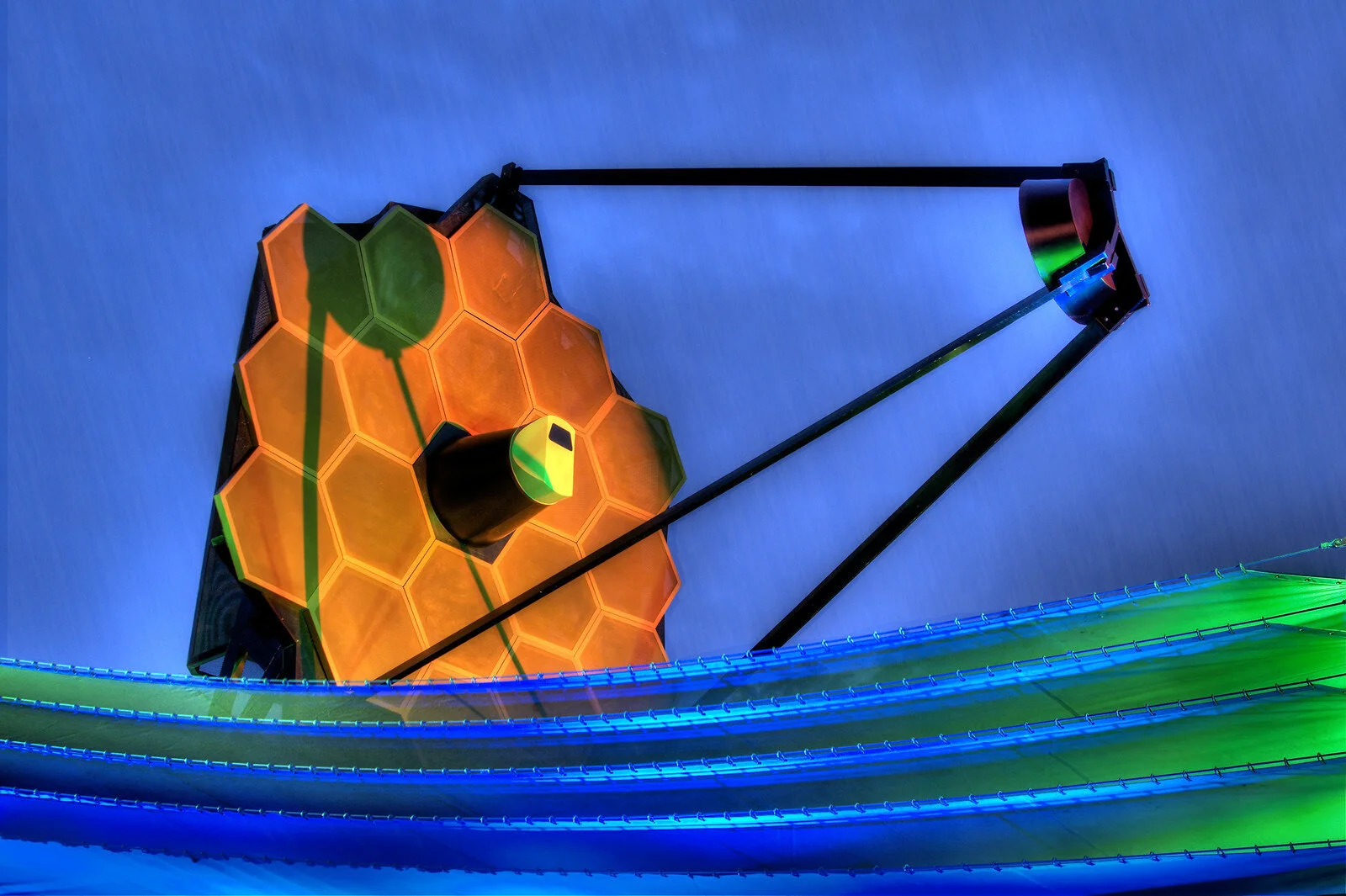
The JWST is the successor to Hubble and, after almost 20 years of construction, is now undergoing a final round of testing before beginning its long-awaited mission in October 2018. The new telescope’s exceptional size, sensitivity and precision instruments will be used to unravel many of the secrets of our universe – from the formation of the earliest galaxies to the detection of atmospheres on planets outside our solar system. Before that can happen, however, scientists and engineers need to fold, like a giant origami model, the 6.5 metre high observatory and its tennis court sized sunshield into an Ariane 5 rocket and blast it more than one and a half million kilometres into space.
Time machine
The JWST is being led by NASA, with significant contributions from the ESA and the Canadian Space Agency. It is designed to study every phase of our cosmic history and will be seven times more powerful than Hubble which, during its 26 years in orbit, has discovered billions of galaxies, stars and planets.
NASA describes the new space telescope as a “powerful time machine with infrared vision”. A “time machine” because, even travelling at the speed of light, some of the electromagnetic radiation that reaches the telescope will have originated billions of years ago, at the very dawn of time.
One of the new capabilities of the JWST is its infrared vision. This will enable the space telescope to detect material through previously impenetrable clouds of cosmic dust. Peering into these clouds should give us the answer to one of astronomy’s biggest mysteries: what were the first luminous objects to form after the Big Bang?
The instrument that will identify these earliest galaxies is the Mid-Infrared Instrument (MIRI). It is fitted with a camera so sensitive it would be able to detect a candle flame on one of Jupiter’s moons.
MIRI is a UK-led project, in partnership with a European Consortium and NASA’s Jet Propulsion Laboratory, and is the result of decades of work headed by Wright, who is also the director of the UK’s Astronomy Technology Centre.
The instrument’s other primary objective will be to reveal, for the first time, planets orbiting stars in other solar systems. “We’ve found lots of these kinds of planets but we don’t know very much about them,” explains Wright. “MIRI offers us the unique opportunity to study them.”
“For the first time ever we’ll have direct images of the planets and we’ll also be able to take spectra,” she adds. “We can look at what the planet is made up of by looking at their chemical signatures from their light.”
Much like shading your eyes from the sun, MIRI will be able to block out star light to examine these planets. “We make a spot that is exactly the size of the image of the star and that stops the light from getting to our detectors,” explains Wright. “You don’t see so much of the light from the star so it’s easier to see the light coming from the planets.”
MIRI is one of four all-important instruments at the heart of the telescope. The others are the Near Infrared Camera (NIRCAM), the Near-Infrared Spectrograph (NIRSpec) and the Fine Guidance Sensor (FGS). Together, they will be able to reveal the universe in a whole new level of detail.
Size Matters
As well as sophisticated instruments, the other thing you need if you want to peer into galaxies 13.5 billions of light years away, is a mirror. A larger mirror will gather more light than a smaller one, much like a bucket will collect more rainwater compared to a teacup.
The primary mirror for the JWST is 6.5 metres in diameter and consists of 18 hexagonal segments made of goldcoated beryllium. Once launched, these segments will unfold and piece together as one immense mirror.
Another engineering feat for the mission is the JWST’s sunshield. Northrop Grumman in Redondo Beach, California, has designed a sunshield the size of a tennis court to shadow the telescope’s instruments to prevent any background heat from interfering with their observations.
The sunshade is made up of five layers of a flexible insulating material called Kapton. The temperature difference between the two sides of the shield is more than 300°C. The sun-facing side has solar panels to power the observatory and the mirror and detectors operate at -233°C on the cold and shaded half.
A Shaky Start
As the launch date approaches, engineers are contending with the challenge of blasting the advanced telescope into space.
In a giant clean room at the Goddard Space Flight Centre in the US state of Maryland, the telescope has been experiencing the violent sounds and vibrations of a rocket launch. This involves forces 10 times stronger than gravity and blasts that rival a rocket explosion. The team has to be certain that nothing disrupts the telescope once it’s inside the Ariane rocket and on its way.
During this whole process, the primary mirror’s precision is continuously assessed to verify that its surface and alignment will not degrade. This ‘Centre of Curvature’ test is fundamental to the telescope’s development.
In early December, during one of the simulated launch tests, one of the restraints on the primary mirror was found to be moving slightly due to the extreme shaking.
“Now that we understand how it happened, we have implemented changes to the test profile to prevent it from happening again,” says Lee Feinberg, an engineer and Optical Telescope Element Manager at Goddard. “We have learned valuable lessons that will be applied to the final pre-launch tests of Webb once it is fully assembled in 2018.
With the schedule back on track, Goddard will up the intensity of the vibrations. Knowing that the JWST can survive conditions more severe than the launch gives Feinburgh and his team “confidence that the launch itself will be fully successful.”
But it’s not just mechanical assessments that are taking place this year. “A lot of the work that is also going on right now is software development,” says Sarah Kendrew, an ESA Instrument Scientist in Baltimore. “We’re making sure we can control the instrument properly.”
“We’ve had successive test campaigns, where more and more hardware gets put together,” says Kendrew. “Now MIRI is just one piece of this enormous telescope and spacecraft.”
In the coming months, the JWST will move to the Johnson Space Flight Centre in Texas, where it will undergo a thermal vacuum test. Using the same chamber that was originally used to test Apollo, the telescope and its integrated instruments will be subjected to chilling temperatures – 40 degrees above absolute zero – to monitor how they will perform in space.
From there, it’s off to California for one final and momentous challenge. The telescope and scientific payload will be attached to the giant sunshield and sailed down the coast to the launch site in French Guiana by mid-2018.
After launch, the scientists will have to wait a few weeks before they know if everything has gone according to plan; the sunshade is cooling and the telescope deploying. With the telescope positioned 1.5 million kilometres from Earth, there is nothing anyone can do to repair any damage. It really does have to be right first time.
With scientific meetings scheduled for later that year, Wright is already looking ahead. “It will probably be about six months after launch that we get the first images back.”
“We’re talking about the plans for early images and how are we going to commission the instruments,” she adds. “It’s a very exciting time.”

WOMEN IN SCIENCE: PLEASE MIND THE GENDER GAP
Why is it that the word “scientist” automatically evokes the image of a 40-something year old male, sporting a lab coat and lacking social skills? And why is it that in an age where gender equality is so important in today’s society, the gender imbalance in science still prevails?

Why is it that the word “scientist” automatically evokes the image of a 40-something year old male, sporting a lab coat and lacking social skills? And why is it that in an age where gender equality is so important in today’s society, the gender imbalance in science still prevails?
It is no secret that when it comes to STEM (Science, Technology, Engineering and Mathematics) there is a significant gender gap. From Nature’s study, in European universities only 11% of the senior science faculty members are female, a great reduction from the already low percentage of those at junior faculty level (33%). Even more shocking is the fact that 6% of UK engineers are women and for roughly the past 20 years only 20% of all Physics A-level students in the country are female.
Moving away from numbers and investigations, one only has to look at the news of this week to find an issue with the female representation in science. Yes, Dr Matt Taylor (of the Rosetta comet mission) did break the “scientist stereotype” but, unfortunately, by wearing a top covered in scantily clad women. Yes, he did publicly apologise for it. But it doesn’t fill aspiring young female scientists with hope, knowing that this is how her male counterparts may view women.
When the creator of the popular Facebook page, I F***ing Love Science, shared her Twitter profile with fans, not only did it reveal her sex but with it the inherent gender bias that is associated with women in Science:
“You mean you’re a girl AND you’re beautiful?”
“Wait, wait, wait, wait! Ur a girl?!”.
“Holy hell you’re a hottie”
The onslaught of these objectifying comments reinforces ideas that science is a male-dominated field, placing image before intellect. However, it is encouraging that some fans were un-phased despite their gender perceptions being subverted, “I’m ashamed to say I assumed you were a man. But I’m neither shocked nor affected in the slightest that you aren’t. Keep on f***ing loving science.”.
Elise Andrew summed it up perfectly in less than 95 characters, “EVERY COMMENT on that thread is about how shocking it is that I’m a woman! Is this really 2013?”.
The gender disparity is obviously not restricted to one area of science nor to a specific academic level, but is all-encompassing. Why is that? And what can be done to reduce this gap?
Why does the gap exist? Does it actually matter?
The first place to evaluate is education. Boys and girls do equally as well in Physics at GCSE level, so why in 2013 did only 10% of the 72,000 girls who achieved an A* to C grade go on to study the subject at sixth form? It’s the same every year, in 2011 46% of co-ed schools in England didn’t send a single female to study Physics at A-level. Perceptions from a young age of STEM subjects being exclusively “for boys” clearly have a damaging effect, which can in turn inhibit a potential career path in years to come. On top of this, unconscious biases develop from the “pink aisle” – toys for young girls focus on objectification as opposed to education and adventure. These are just a few stereotypes that need to be challenged from an early age.
At 16, students are expected to make decisions that shape their future and it’s at this age where females are likely to miss out on the opportunity of a career in engineering. It is estimated that between now and 2020, the UK needs 87,000 graduate engineers each year. But only 46,000 are currently produced annually. In 2012/13 one in six engineering and technology students were female. An increase of females in Physics at A-level would open the potential for a career in engineering, which would not only reduce the gender gap but fight the misconception that it’s a “boys’ subject”, as well as having a beneficial impact on the economy.
Moving onto higher education and academic careers, there is male dominance when it comes to decision-making, be that for editorial boards, academic selection committees, grant reviewing boards etc. Women are hardly present at all within these roles, which adds to the impression that STEM subjects are for men.
The Royal Society of Chemistry found that the number of females that wanted to continue into research had dropped from 70% to 37% from first to third year, with one contributing factor being that female students “conclude consciously and unconsciously that these careers are not for them because they don’t see people like them”. It is the responsibility of a university or department to ensure that they offer the support female students may need throughout their academic experience to prevent this number from dropping as much as possible. There are various factors as to why a student may change their mind on continuing their studies, but “this sense of not belonging” should not have to be one.
How do we tackle this? What is already being done?
By implementing quotas within various committees a step can be taken towards a balanced representation, providing female scientists with female role models. Being realistic, it may be appropriate to keep this value initially low as to not overburden female members, especially if they’re on a decision making committee.
Nobel laureates have created foundations to support women in science. For example, the Rita Levi-Montalcini Foundation supports young African women who want to become scientists and the Christiane Nüsslein Volhard Foundation supports female scientists with children.
In the UK there are various initiatives to support women in science, with many starting at a school level. Science Grrl promotes that “Science is for everyone” and has been co-operating with a number of STEM sectors to encourage girls become more involved with these subjects. In addition to this, they created and presented a report to the Government to start the discussion with academics, educators and STEM community as to how they can work together to reduce this imbalance. They also deduced that there are three factors that contribute to choosing a career in STEM, regardless of gender and should be considered in all initiatives: 1) Relevance of STEM – Is it for people like me? 2) Perceived ability – Do I feel confident? 3) Science capital – Can I see the pathways and possibilities?.
Another programme that supports women “from classroom to boardroom” is WISE. They actively tackle the “pipeline issue” of female talent within STEM subjects and aim to push the presence of female employees from the current 13% to 30% by 2020.
There is no one solution or initiative that will resolve gender imbalance in science. Unfortunately there are stereotypes, both extreme and small, that are embedded deeply within science and society. It is the responsibility of women and men to work together to challenge them and to create future empathetic leaders in children to prevent the problem deteriorating.
Not only is the gender gap an issue of social justice but also of economy. As Nature stated, “no country can afford to neglect the intellectual contributions of half its population”. More needs to be done by the academic system, be that the Government, teachers, lecturers or external initiatives, to actively encourage females to study STEM subjects at A-Level and further. Doing so increases the progress of women’s involvement in the scientific workforce and produces role models to ensure such progress continues.